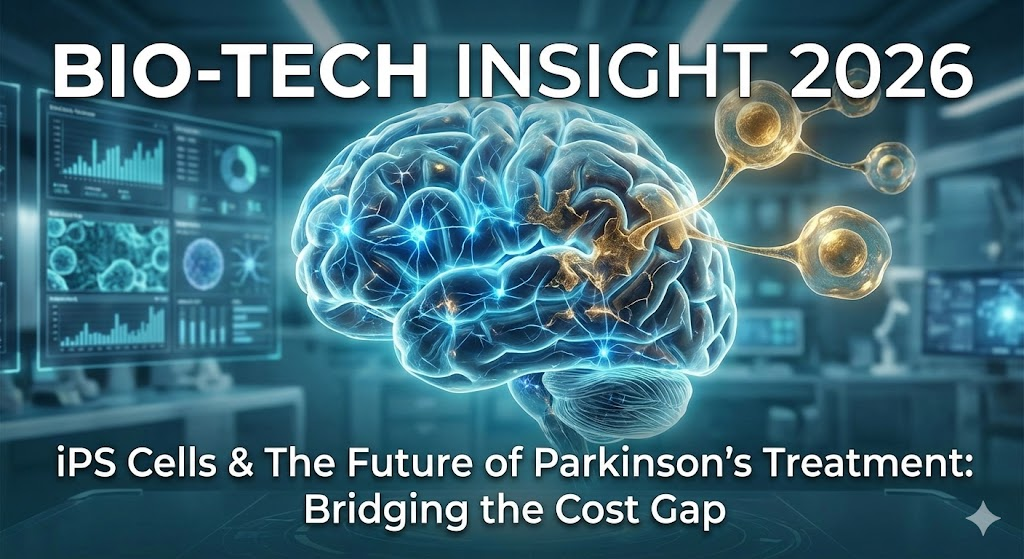
🏁 [Overview] Technical Breakthrough vs. Economic Reality The landscape of regenerative medicine is shifting rapidly. Recent reports from Japan’s Sankei News highlight a significant milestone: iPS cell-based therapy for Parkinson’s disease, developed by Kyoto University and Sumitomo Pharma, is nearing commercial approval. While the scientific community celebrates this “cure,” we must ask a critical question for 2026: Can this innovation scale beyond the laboratory and overcome the “cost barrier” for ordinary families?
1. The Bio-Tech Shift: How AI Scales Regenerative Medicine
The core of this breakthrough lies in iPS cells (Induced Pluripotent Stem Cells)—essentially “master cells” that can be reprogrammed to replace damaged neurons in the brain.
- The AI Advantage: Historically, mass-producing these cells was a bottleneck. Today, AI-driven monitoring systems manage the cultivation process in real-time, ensuring consistent quality and significantly reducing the time to market.
- Market Growth: As we enter 2026, the regenerative medicine sector is no longer a speculative niche but a multi-billion dollar pillar of the global “Silver Economy.”
2. The Caregiver’s Perspective: A Reality Check
Beyond the flashy headlines lies a sober reality. As a CEO currently caring for two 90-year-old parents suffering from dementia, I view these advancements through a lens of pragmatic urgency.
- The Time Gap: For patients in their 90s, “availability in 5 to 10 years” is often a lifetime too late.
- The Financial Hurdle: If cutting-edge therapies cost hundreds of thousands of dollars, they remain a luxury for the elite rather than a solution for the masses. The true “pain point” for caregiving families is not just the lack of a cure, but the lack of affordable, accessible support.
3. [Insight] The Future of Med-Tech: Accessibility is the Ultimate Innovation
The success of a trend is not measured by its complexity, but by its impact.
- Economic Feasibility: For Bio-Tech to truly revolutionize society, the focus must shift from “discovery” to “distribution.”
- My conclusion is this: Real innovation happens when technology touches the lives of the many, not the few. As we track the 2026 trends, we must demand that Bio-Tech advances not just in capability, but in compassion and affordability. True progress is measured by how effectively we can alleviate the burden on the families waiting in the trenches of caregiving.
Leave a Reply