Introduction : Recently, the concept of “AI Judges” has become a hot topic in the tech and legal sectors. But beyond the technological shifts in the legal market, how will AI fundamentally reshape human jobs, institutions, and our class structure? Following a deep, late-night conversation with an AI, I’m sharing these raw, realistic, and somewhat chilling insights into our future.
1. Will AI Judges Actually Put Human Judges Out of Work?
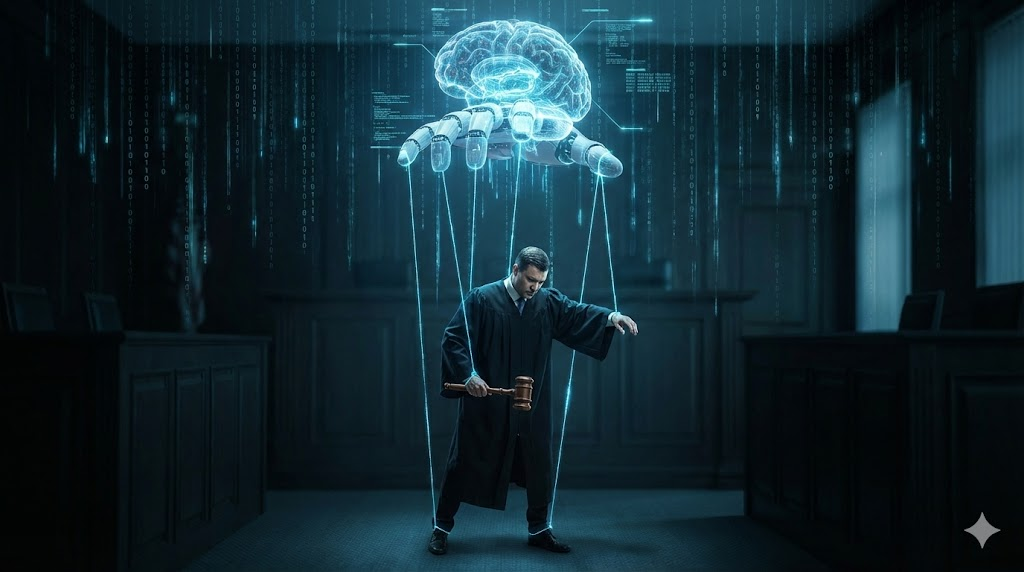
AI can analyze tens of thousands of precedents in seconds, completely free from emotional bias or fatigue. So, are human judges about to become obsolete?
The short answer is ‘no.’ The courtroom is where people’s wealth, freedom, and even lives are on the line. The heavy burden of accountability for those fatal decisions must inevitably be borne by humans, through social consensus. Furthermore, AI cannot read the “context” behind a crime or the genuine “remorse” in a defendant’s eyes.
Just as the invention of ATMs didn’t eliminate bank tellers but evolved them into financial advisors, human judges will likely delegate the heavy paperwork to AI assistants. This will free them to focus exclusively on the most complex moral and philosophical judgments.
2. The Extinction of the “Memorization Genius” and the Rise of a New Breed
Will lawmakers and the establishment naturally evolve to keep up? History shows that legislation is always slower than technology. They won’t evolve voluntarily; they will be forced to adapt by global capital and immense market pressure.
In this massive paradigm shift, the traditional “geniuses” who merely memorize vast amounts of knowledge and calculate quickly are facing extinction. AI simply does it faster and flawlessly. The new genius of this era isn’t someone who holds all the answers. The new standard of brilliance belongs to the person who knows how to ask the right questions (prompts) and seamlessly connect the AI’s output to real-world business and revenue.
3. The Regulatory Void and the 0.0001%’s Rule-Setting
Because the law is inherently slower than technological innovation, a massive “speed gap” or regulatory void emerges. The chilling reality is that the top 0.0001%—the mega-corporations and the elite—will monopolize AI to exploit these loopholes first.
They will establish the new legal boundaries and algorithms in their favor, consolidating their wealth before the public even catches on. The masses will likely end up living passively within the credit, loan, and employment algorithms engineered by this elite group. We are not heading toward a world ruled by AI, but rather a world ruled by the 0.0001% who control the AI.
4. The Modern “Bread and Circuses” and Dystopian Polarization
What happens when AI replaces countless jobs, and the government hands out Universal Basic Income (UBI) along with unlimited data and entertainment? It becomes the ultimate, cheapest sedative to prevent social unrest and maintain the status quo—a modern-day version of the Roman “Bread and Circuses.”
However, humanity risks losing its sense of purpose and self-actualization through work, potentially falling into deep collective nihilism. Even worse is the extreme concentration of wealth. While the masses lie back, endlessly consuming dopamine-fueled content in virtual worlds, all the capital will be sucked into the black hole of the ultra-minority “producers” who design these platforms.
My thinkilg: Will You Be a Consumer of Dopamine, or a Producer?
We might not be able to change the massive undercurrents of global systems and laws right now. But we can certainly use AI as a precise compass to navigate our own ships to our desired destination.
Will you remain a mere “consumer,” swept away by endless, mindless entertainment provided by the system? Or will you build your own digital real estate, leverage AI as a tool, and position yourself as a “producer” who creates real value? This is the most urgent question we face as we step into this new era.
Leave a Reply